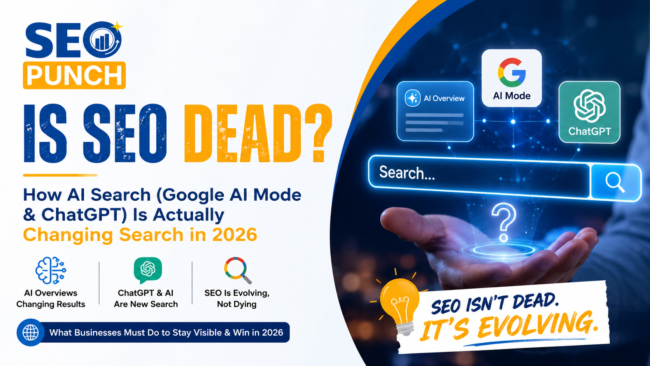
Is SEO Dead? How AI Search (Google AI Mode & ChatGPT) Is Actually Changing Search in 2026
The Question Everyone in Digital Marketing Is Asking “Is SEO dead?” This question has been floating around Google, Reddit, and every marketing group on LinkedIn for the past year. And it makes sense why people are asking it. Google’s AI Overviews now sit right at the top of search results, answering questions directly. ChatGPT, Gemini, and other AI tools are becoming the first stop for millions of people instead of typing into a search bar. Fewer clicks are landing on websites. So it’s a fair question. But here’s the honest answer. SEO is not dead. It’s changing shape, and business owners who understand the shift are going to win big, while the ones who ignore it are going to quietly lose traffic without ever knowing why. Let’s break down what’s actually happening. What’s Actually Changing in Search 1. AI Overviews Are Eating Clicks Google’s AI Overviews now appear above the regular search results for a huge number of queries. Instead of clicking through to a website, many users get their answer directly on the results page. This is called a zero click search, and it’s becoming more common every month. This means fewer people are landing on your website for simple, informational questions like “what is local SEO” or “how does Google ranking work.” 2. Google AI Mode Is Changing How People Search Google AI Mode lets users have a back and forth conversation with search, almost like chatting with an assistant, instead of typing a keyword and scrolling through ten blue links. This changes what kind of content actually gets pulled into results. Short, vague, keyword stuffed content struggles here. Clear, well structured, genuinely useful content performs better. 3. ChatGPT and AI Chatbots Are a New Search Channel More and more people are asking ChatGPT, Gemini, and other AI tools questions they used to type into Google. This has created an entirely new discipline some people call generative engine optimization, or GEO. It’s about making sure your business and your content get mentioned when AI tools generate answers, not just when someone scrolls through search results. 4. Voice Search Is Quietly Growing Too Voice search through phones and smart speakers has been growing for years, and it’s now merging with AI search in a big way. When someone asks a voice assistant a question, the answer usually comes from a single source, not a list of ten links. That makes ranking in position one, or being the source an AI trusts, more valuable than ever. 5. Google Algorithm Updates Are Moving Faster Google used to roll out a few major algorithm updates each year. Now, updates related to AI, spam, and content quality are happening more frequently and with less warning. Businesses that rely on outdated SEO services or old link building tricks are getting hit harder and recovering slower than before. How This Affects Organic Traffic and Rankings Many website owners have already noticed a drop in organic traffic even though their rankings in the traditional sense have not dropped much. This is one of the most confusing parts of the AI search shift. A page can still rank on the search engine results page, or SERP, but get fewer actual clicks because the AI Overview above it already answered the question. This is why looking only at your ranking position is no longer enough. Businesses need to check Google Search Console regularly, watch click through rates, not just rankings, and pay attention to how many of their impressions are turning into real visits and real leads. What This Means for Content Marketing Strategy A strong content marketing strategy in 2026 looks different from one in 2020. Thin, generic blog posts written purely to target a keyword are losing ground fast. What performs better now is content that shows real experience, answers the full question a person actually has, and is structured clearly enough for both humans and AI systems to understand quickly. This is also why working with a proper SEO agency in Mumbai, or any experienced SEO services provider, matters more now than it used to. It’s no longer just about stuffing keyword research into a page. It’s about combining keyword research, real expertise, and a genuine content marketing strategy that builds long term online visibility. Real Examples of How This Is Playing Out Recipe and how-to websites have been hit especially hard by AI Overviews, since a simple recipe or step-by-step answer is exactly the kind of content Google can now summarize directly on the results page without sending a click to the original website. Local service businesses, on the other hand, have barely felt the impact. Someone searching for a plumber, electrician, or dentist near them still needs a real business to call, book, or visit, which is something an AI answer cannot replace. This is a big part of why local SEO and Google Business Profile optimization remain some of the safest, highest return investments for small businesses right now. E-commerce brands are seeing a mixed picture. Generic product information gets summarized by AI tools easily, but detailed comparisons, genuine reviews, and unique product content still drive real traffic and real sales. The pattern across all of these is simple. The more replaceable your content is, meaning the more it reads like something an AI could generate in two seconds, the more exposed you are. The more your content reflects real experience, a real business, or a real local presence, the safer you are. Common SEO Myths Going Around in 2026 Myth: Backlinks don’t matter anymore. False. Backlinks from real, relevant websites remain one of the strongest ranking factors and trust signals, both for traditional search engine optimization and for how AI tools evaluate credibility. Myth: You should write content only for AI, not for humans. False. Writing content that reads naturally for a real person is exactly what performs best with both Google’s algorithm and AI tools. Content written awkwardly just to please a machine tends to perform worse, not better.…